
This is a to-do list, not a class. Make these calls, file these forms, and use the scripts below. For the “why” and the details, follow the links to our other guides.
A useful order for money help is: foundation bill-pay first, then hardship or forbearance programs, then savings, then retirement funds last. The point is to delay dipping into savings and retirement if a foundation or a temporary hardship plan can cover a bill. This is not financial, legal, or tax advice, and no program is a promise.
For the rest of week one (your care team, insurance calls, and a meal train), see Your First Week: A Checklist and The First 72 Hours.
Prefer paper?
Download a free booklet you can print and take to the hospital. It has the flowchart, the day-by-day checklists, the SAY THIS scripts, and notes pages for names, claim numbers, and what each person told you. For the most up-to-date version, use this web page. Free, no sign-up needed.
https://staging.yourcrisisguide.com/wp-content/uploads/2026/11/first-10-days-booklet-pages.pdf
https://staging.yourcrisisguide.com/wp-content/uploads/2026/11/first-10-days-booklet-print.pdf
To print it as a folded booklet, use the folded-printing file. Print on US Letter paper, both sides, at actual size (100 percent). Do not scale it to fit. Try “flip on short edge” first. If the back of a sheet comes out upside down, switch to “flip on long edge.” You should get 7 sheets. Keep them in the printed order, fold in half, and staple on the center fold.
Show only the steps that fit your family (optional)
Tick what applies. Your answers stay on this screen. They are not saved or sent anywhere.
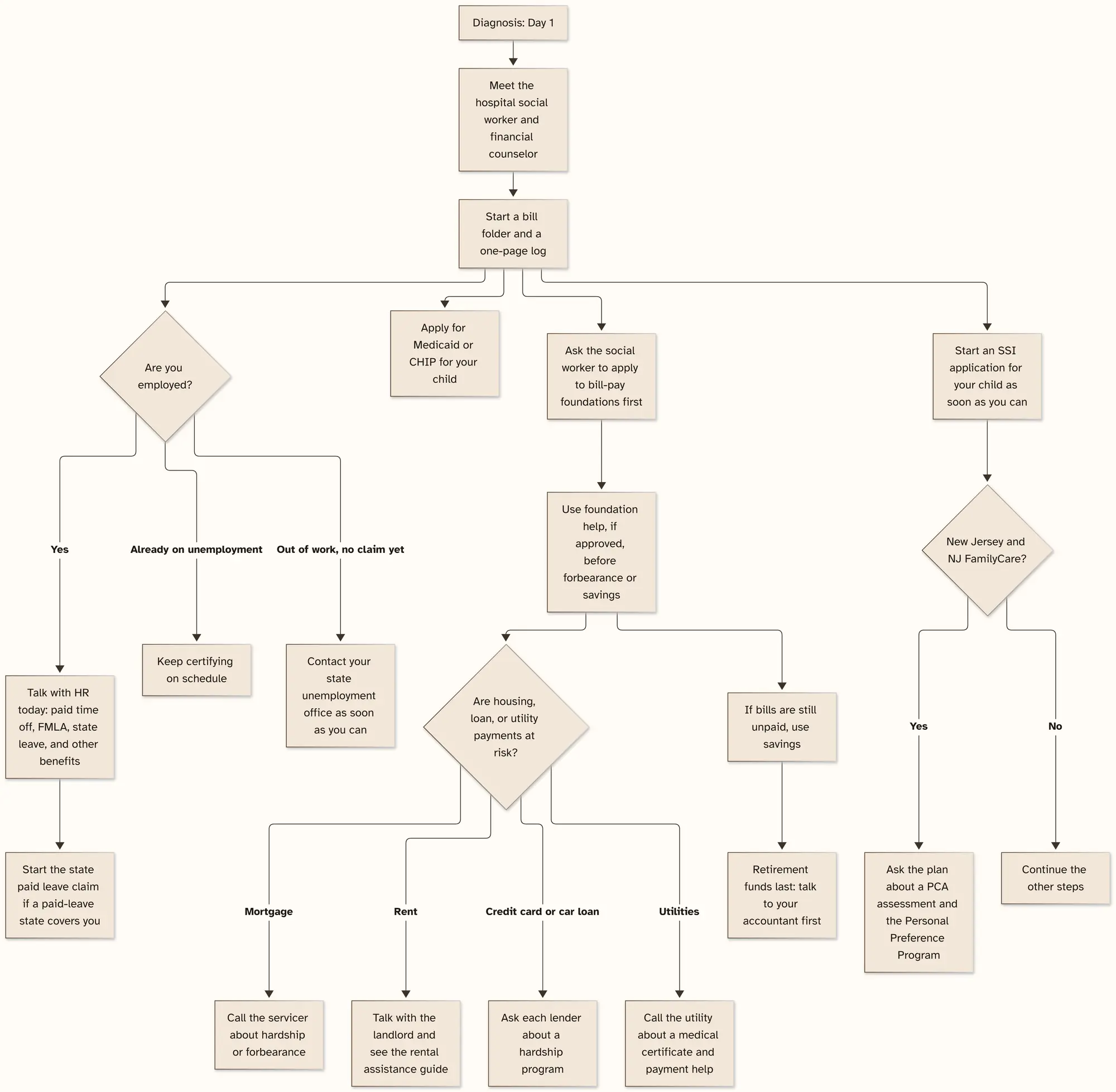
Diagnosis, day 1: Meet the hospital social worker and financial counselor
Full wording: Day 1 to 2 checklist.
Start a bill folder and a one-page log
Full wording: Day 1 to 2 checklist.
Then start these four. They run side by side.
Work
Are you employed?
Yes: Talk with HR today: paid time off, FMLA, state leave, and other benefits. Then start the state paid leave claim if a paid-leave state covers you.
Already on unemployment: Keep certifying on schedule.
Out of work, no claim yet: Contact your state unemployment office as soon as you can.
Full wording: Day 1 to 2 checklist and Day 3 to 5 checklist.
Bills
Ask the social worker to apply to bill-pay foundations first
Use foundation help, if approved, before forbearance or savings.
Are housing, loan, or utility payments at risk?
Mortgage: Call the servicer about hardship or forbearance.
Rent: Talk with the landlord and see the rental assistance guide.
Credit card or car loan: Ask each lender about a hardship program.
Utilities: Call the utility about a medical certificate and payment help.
If bills are still unpaid, use savings. Retirement funds last: talk to your accountant first.
Full wording: the foundations list and Day 6 to 10 checklist and what to say on each call.
SSI
Start an SSI application for your child as soon as you can
New Jersey and NJ FamilyCare?
Yes: Ask the plan about a PCA assessment and the Personal Preference Program.
No: Continue the other steps.
Full wording: Day 1 to 2 checklist and Day 3 to 5 checklist.
This map is also in the booklet as a one-page picture. See the whole map as a picture.
What you need to know first
Do the hospital meetings and the employer or unemployment steps on day one, even if you are exhausted. Start the foundation applications as soon as the social worker can file them. Wait to call the mortgage company, credit card issuer, car lender, or utility about hardship until those applications are in, unless a shutoff, eviction, or repossession is already in motion. If that is happening now, make that call today and still start the foundation paperwork.
Who does the work: you make the calls and complete the parts that ask for a parent. The social worker often has to submit foundation forms. The hospital financial counselor can help you start a Medicaid or CHIP application. Who decides: each employer, agency, lender, utility, and foundation, using its own rules. For Medicaid and CHIP, the state Medicaid or CHIP agency decides.
Day 1 to 2
- ☐ Tell the nurse you want to meet the hospital social worker and the financial counselor today or tomorrow. Inpatient, they can come to the room. See Questions to ask the hospital financial counselor and social worker. For reading a hospital bill and asking about charity care, see Charity care and how to read a medical bill.
- ☐ Start a bill folder: rent or mortgage statement, utility bills, car payment, insurance, pay stubs or a leave letter, and a one-page log of whom you asked and when.
- ☐ If you are employed, talk with your HR representative or business partner today, and follow up in writing. Have an open and honest conversation about your options. You may be able to use your paid time off and still get paid before you file for FMLA or other benefits. The U.S. Department of Labor says you may elect, or your employer may require you, to use accrued paid vacation, sick, or family leave for some or all of an FMLA leave period. Also ask HR, or check your benefits materials, whether you have other coverage to ask about, such as a critical illness policy. Request FMLA and any state family leave in writing. A diagnosis is often not foreseeable, so DOL says to give notice as soon as practicable, generally the same or next business day, and to follow your workplace call-in rules. Details are in our FMLA guide. If you may not qualify for FMLA, see Work options if you don’t qualify for FMLA.
- ☐ If you already have an unemployment claim, complete your next certification on time and report any work. Do not let the claim lapse.
- ☐ If you are out of work and do not have a claim, contact the unemployment office in the state where you worked as soon as you can. The Department of Labor says you usually qualify if you are unemployed through no fault of your own. In most states, that means a lack of available work. Do not assume you will get benefits if you quit to provide care. Who decides: your state unemployment program.
- ☐ Ask the social worker, today, to apply to the bill-pay foundations listed below, and to check which other funds they use. Bring the actual bills, in the account holder’s name.
- ☐ Start a Medicaid or CHIP application for your child (the patient) right away, even if a parent has employer insurance. Apply through your state Medicaid agency or at HealthCare.gov. Ask the hospital financial counselor to help; many hospitals screen families and help you file. You can apply any time of year. HealthCare.gov says you should apply even if you do not think you will qualify based on income, and that in certain states CHIP covers children in families that earn too much for Medicaid. Rules vary by state. New Jersey: this program is called NJ FamilyCare. Call 1-800-701-0710, or see our Medicaid guide. HealthCare.gov currently says Medicaid may be able to help pay for medical care from the last 3 months if you would have been eligible then. That window is scheduled to get shorter for applications made on or after January 1, 2027, so do not wait. Who decides: your state Medicaid or CHIP agency.
New Jersey: The NJ FamilyCare site says applications not submitted by December 31, 2026, will be closed, and a new application is needed on or after January 1, 2027.
- ☐ Start an SSI application for your child as soon as you can, online at ssa.gov/apply/ssi or by calling Social Security at 1-800-772-1213. SSA says it cannot pay for time before the effective date of your application, and that if you call for an appointment, keep it, and then file, it may use the date of your call as the filing date. Who decides: Social Security. See our Social Security Benefits guide.
Day 3 to 5
- ☐ Finish your part of each foundation application. Give the social worker clear copies of the bills, including account numbers and amounts due.
- ☐ Give your child’s doctor the medical forms for leave: FMLA certification if HR asked for it, the New Jersey FLI instructions if you started an online claim, and New York Form PFL-4 if you are filing Paid Family Leave. Ask the clinic who handles leave forms, and follow up in a few days if the form has not gone out.
- ☐ If your employer requested FMLA medical certification, DOL says the employer must allow at least 15 calendar days to get it, unless that is not practicable despite your diligent, good-faith efforts.
- ☐ New Jersey: If you work in New Jersey and your leave has started or will start, create an account and file Family Leave Insurance at myleavebenefits.nj.gov.
You have 30 days from the first day of leave to file.
Late claims can be reduced or denied. You may start an online application up to 60 days in advance. See the official FAQ. Who decides: the New Jersey Division of Temporary Disability and Family Leave Insurance, or your employer’s private plan if you have one. - ☐ New York: If you are covered by Paid Family Leave, notify your employer at least 30 days before leave starts if it is foreseeable. If it is not, notify them as soon as possible. Complete Form PFL-1 and give it to your employer, which must return it within three business days. Submit the completed package to the employer’s insurance carrier within 30 days after your leave starts, or you can lose benefits. Forms and steps are on the official family-care page. Helpline: 844-337-6303. Who decides: the insurance carrier.
- ☐ If you live or work in another paid-leave state, see Family and Medical Leave Insurance (FMLI) and file as soon as you can, unless that state’s official page lists a deadline.
- ☐ New Jersey only: If your child already has NJ FamilyCare, call the member services number on the card and ask for a Personal Care Assistant assessment and about the Personal Preference Program. PPP is for NJ FamilyCare members who are approved for PCA services and need them for at least six months, and who can self-direct or have a representative who can. You may be able to hire a trusted person, including a relative, under program rules. If your child does not have NJ FamilyCare yet, start with the financial counselor and our Medicaid guide. Who decides: the managed care plan and the state program.
- ☐ Follow up on the Medicaid or CHIP application for your child if it is not yet filed. Ask the financial counselor where it stands.
Day 6 to 10
- ☐ Follow up with the social worker on every foundation request. Write the date and the answer in your log.
- ☐ If a needed bill is still unpaid, then call the mortgage servicer, landlord, credit card company, car lender, or utility. Try foundations first so you can delay forbearance and savings if a grant comes through. If a shutoff, eviction, foreclosure, or repossession is already in motion, do not wait.
- ☐ Mortgage: Call the number on your statement. The CFPB says to call the servicer right away if you are worried about a payment, explain the hardship, and ask what options exist, which may include forbearance. Forbearance pauses or reduces payments for a time. You still owe the money, and you have to repay what you missed. Ask how interest works and how you will repay before you agree. Get it in writing. Free help: a HUD-approved housing counselor, or 888-995-HOPE (4673). Who decides: your servicer. See Mortgage Assistance.
- ☐ Rent: Talk with the landlord, and see Rental Assistance Programs.
- ☐ Credit cards: The CFPB says to contact the company immediately, explain why you cannot pay the minimum, how much you can pay, and for how long. Ask for the terms in writing.
- ☐ Car loan or lease: The CFPB says to contact the lender or servicer as soon as you know you may miss a payment, ask what options exist, and get any agreement in writing, including how it could affect your credit report.
- ☐ Utilities: Call the company on the bill, ask about a payment plan and a medical certificate, and see Utility Assistance. New Jersey: The BPU customer-rights page says a utility may not turn off service, outside a safety emergency, if a valid medical emergency exists in your household. You also have a right to at least one deferred payment plan a year if you have a bill you cannot pay, and at least 10 days’ written notice before a shutoff for non-payment. Ask the company what medical documentation it needs. For assistance programs, call the utility or 2-1-1. BPU Customer Assistance: 1-800-624-0241. New York: Under HEFPA, if a doctor or the local Board of Health notifies the utility that a medical emergency exists that would be aggravated by a lack of service, the utility must keep service on for 30 days. Phone notice must be followed within five business days by a written certification. The certificate may be renewed if the rules on that page are met. You still need to make a reasonable effort to pay. Department of Public Service helpline: 1-800-342-3377. If service is about to be shut off: 1-800-342-3355 on business days. Who decides: the utility, under state rules. Rules in other states vary.
- ☐ Do not take money from a retirement account yet. If you are considering it, talk to your accountant first. The IRS pages on this are hard to follow. There may be an exception to the extra tax that can apply to early withdrawals when the money is for medical expenses. See the IRS page on exceptions for retirement plans other than IRAs, and the IRA exceptions page. Your accountant should tell you what, if anything, applies to you. This is not tax advice.
Within 30 days, where a real deadline exists
- ☐ New Jersey Family Leave Insurance:
You have 30 days from the first day of leave to file.
See the official FAQ. - ☐ New York Paid Family Leave: if the leave was foreseeable, you should have given your employer 30 days’ notice. In all cases, get the completed request to the insurance carrier within 30 days after leave starts (official family-care page).
- ☐ Finish any remaining FMLA forms. If certification was requested, remember the 15-calendar-day window unless a shorter time was not allowed under the DOL rule above.
- ☐ If you lose job-based health coverage, a Marketplace Special Enrollment Period is a different clock. HealthCare.gov says you generally have 60 days. See Insurance Navigation.
For other tasks on this page, if there is no official deadline, do them as soon as you can.
Bill-pay foundations to start this week
These are national programs that, when we checked on November 16, 2026, were set up to help with household bills for families of a child with cancer and had a current way to apply. Funds open and close. A request is not a promise. Who decides: each foundation.
We could not confirm five national programs that were clearly open for general household bills on that date. We listed only the ones we could verify. Ask the social worker to check their usual list as well, including groups in Financial Assistance Foundations and Local foundations and your hospital social worker.
- The B+ Foundation Family Assistance Program. Helps with expenses tied to the diagnosis, including mortgage or rent, and pays creditors directly. For a child under 21 treated at a U.S. hospital. Assistance may be granted once in a 12-month period, and twice overall. You complete page 1. The social worker completes page 2. Both parts must be done before a review. Applications are reviewed on Fridays, with some exceptions. Ask the social worker for the online form.
- Go4TheGoal Family Support. Helps with household bills, treatment travel, and other needs. Only a social worker, child life specialist, or other hospital staff may request help, by emailing PatientRequest@Go4theGoal.org. The foundation says it responds to all requests within 24 hours. Families do not apply on their own.
- Children’s Cancer Recovery Foundation Helping Hands Fund. Makes emergency bridge payments directly to utility companies and landlords. The social worker or child life specialist gets the application during the monthly funding window. Applications are due by the 15th of the month.
Also ask the social worker to look at Family Reach in their portal this week. Family Reach can make grants for mortgage or rent, utilities, groceries, and transportation when a matching fund is open, and a healthcare team member has to apply. On the date we checked, the public fund list was limited to certain specialty funds, so do not assume a general pediatric fund is open.
Programs we checked that were not a fit for this first-10-days list: Pinky Swear’s application was under construction and not open. Blood Cancer United’s Pediatric, Adolescent and Young Adult Urgent Need Fund was listed as closed. The National Children’s Cancer Society Emergency Assistance Fund can help with mortgage, rent, or utilities, but only after 30 consecutive days inpatient or away from home in the past 90 days, so it is usually not a day-one application. Ronald McDonald House is lodging, not household bill-pay.
SSI is the Social Security program to start based on your child’s disability and the family’s income and resources. Social Security Disability Insurance is for a worker who has paid Social Security taxes and has a disability, or for certain family members when a parent already receives retirement or disability benefits, or has died. A child’s diagnosis does not, by itself, put a parent on SSDI.
SAY THIS
Use these in your own words. They ask for information and next steps. They do not make a legal claim, and they are not advice.
Hospital financial counselor
“Our child was just diagnosed. Please give me the hospital financial assistance policy and the application today. Please help us apply for Medicaid or CHIP for our child, and please screen us. A parent may be stepping back from work, so our income could change. What do you need from me this week?”
Employer or HR
“My child has a serious health condition, and I need leave to provide care. I would like to have an open and honest conversation about my options. Can I use my paid time off first, while I am still getting paid, before or along with FMLA? I am also requesting FMLA leave and any state family leave I may be eligible for. Please send the forms you need, and please confirm in writing whether I am eligible and what the next steps are. Do we have other benefits I should ask about, such as critical illness coverage? I will follow our usual call-in process.”
Mortgage servicer
“Our family has a medical hardship after our child’s diagnosis, and I am worried about making this payment. What hardship or forbearance options exist on this loan, and what do you need from me? Please explain how any paused or reduced payments would be repaid, and how interest would work, before I agree to anything. Please send that in writing.”
Credit card company or car lender
“Our family has a medical hardship after our child’s diagnosis, and I may not be able to make the full payment. What hardship programs or temporary payment options do you offer? I can pay about [amount] starting [date]. Please tell me, in writing, the terms, how long they last, and how this could appear on my credit report.”
Utility company
“Our child has a serious medical condition, and we are having trouble paying this bill. Do you accept a medical certificate or a doctor’s letter to protect the account from shutoff, and what exactly should it say? What payment plans or assistance programs are available? I will send whatever documentation you require.”
What this guide can and can’t do
This page helps you know what to do first, whom to call, and where to file. It is not medical, legal, financial, or tax advice. Eligibility, deadlines, and dollar amounts are set by each program and can change. If a deadline is not listed here from an official source, do the step as soon as you can. Talk to a lawyer, legal aid, a housing counselor, your plan administrator, or a tax professional when a decision could affect your job, your home, or your taxes.
Programs change. If a link here is out of date, tell us so we can fix it for the next family.
Related guides
- Your First Week: A Checklist
- Questions to Ask the Hospital Financial Counselor and Social Worker
- Financial Assistance Foundations
- Family and Medical Leave Act (FMLA)
- The First 72 Hours
- Medicaid
Prefer paper?
Download a free booklet you can print and take to the hospital. It has the flowchart, the day-by-day checklists, the SAY THIS scripts, and notes pages for names, claim numbers, and what each person told you. For the most up-to-date version, use this web page. Free, no sign-up needed.
https://staging.yourcrisisguide.com/wp-content/uploads/2026/11/first-10-days-booklet-pages.pdf
https://staging.yourcrisisguide.com/wp-content/uploads/2026/11/first-10-days-booklet-print.pdf
To print it as a folded booklet, use the folded-printing file. Print on US Letter paper, both sides, at actual size (100 percent). Do not scale it to fit. Try “flip on short edge” first. If the back of a sheet comes out upside down, switch to “flip on long edge.” You should get 7 sheets. Keep them in the printed order, fold in half, and staple on the center fold.
Sources
Each link was opened and checked on November 16, 2026.
- FMLA Frequently Asked Questions, U.S. Department of Labor
- FAQ: Family Leave Insurance, New Jersey Department of Labor and Workforce Development
- Family Leave Insurance, New Jersey Department of Labor and Workforce Development
- Paid Family Leave for Family Care, New York Paid Family Leave
- How Do I File for Unemployment Insurance?, U.S. Department of Labor
- If I can’t pay my mortgage loan, what are my options?, Consumer Financial Protection Bureau
- What is mortgage forbearance?, Consumer Financial Protection Bureau
- What should I do if I can’t pay my credit card bills?, Consumer Financial Protection Bureau
- What should I do if I can’t make my car payments?, Consumer Financial Protection Bureau
- Customer Assistance, Consumer Rights, New Jersey Board of Public Utilities
- Your Rights as a Residential Gas, Electric or Steam Customer under HEFPA, New York State Department of Public Service
- SSI Application Process and Applicants’ Rights, Social Security Administration
- SSI for Children, Social Security Administration
- Can children and students get Social Security benefits?, Social Security Administration
- Personal Preference Program (PPP), New Jersey Division of Medical Assistance and Health Services
- Topic no. 558, Additional tax on early distributions from retirement plans other than IRAs, Internal Revenue Service
- Topic no. 557, Additional tax on early distributions from traditional and Roth IRAs, Internal Revenue Service
- Need Help? The B+ Foundation Family Assistance Program, The Andrew McDonough B+ Foundation
- Family Support, Go4TheGoal
- Helping Hands Fund, Children’s Cancer Recovery Foundation
- Financial Assistance, Family Reach
- application-update-October-2026, Pinky Swear Foundation
- Urgent Need Program, Blood Cancer United
- Financial Assistance, The National Children’s Cancer Society
- Special Enrollment Periods, HealthCare.gov
- Medicaid and CHIP coverage, HealthCare.gov
- NJ FamilyCare, New Jersey Department of Human Services
- Upcoming Federal Medicaid Changes, Michigan Department of Health and Human Services (describes the federal retroactive-coverage change for applications on or after January 1, 2027)
Want to know when we add new guides? Create a free account and tick the email updates box. It takes about a minute and asks for no payment details. Every guide stays free to read without one.